
Find tutor 🔍
How much tutoring does your child need?

Choose a Year 3 domain: Open Numeracy, Reading, Writing or Conventions of Language. Each domain includes three practice tests.
Year 3 is the first scheduled NAPLAN year. For many children, the unfamiliar parts are not only the questions. They are also the instructions, the change of routine, the need to keep moving, and the experience of completing several assessment domains. A good first practice session should make those processes familiar without turning the week into a high-pressure event.
The Year 3 library is designed to let families begin gently. Start with one subject and one complete set. The first attempt gives you a useful starting point. The answers, explanations and skill information can then help you choose one or two small areas to revisit before another full test is attempted.
Your support matters at this age. Prepare the space, explain how the pack is organised, help with general instructions when appropriate, and reassure your child. Keep the individual answers independent so the paper shows what feels comfortable and what still needs teaching.
Choose a Year 3 domain
For a first NAPLAN year, choose the domain that feels easiest to approach calmly. The skill previews help you decide whether a short conversation or activity would be more useful than a complete paper.
Each card previews three important Year 3 skills and names the files included across the domain’s three tests. Open the full domain page for its six-part skill map and download cards.
Numeracy practice tests
NAPLAN Numeracy draws on number and algebra, measurement and geometry, and statistics and probability.
Important Year 3 skills:
- Place value and number relationships
- Addition, subtraction and equal groups
- Fractions and number patterns
Each of the three test cards provides:
- Numeracy question paper
- Answer key and worked solutions
Reading practice tests
NAPLAN Reading asks students to understand and interpret a range of written and visual texts.
Important Year 3 skills:
- Direct information
- Sequence and simple connections
- Main idea, purpose and audience
Each of the three test cards provides:
- Reading question paper
- Original reading magazine
- Answer key and explanations
Writing practice tests
NAPLAN Writing asks students to create a response to a prompt.
Important Year 3 skills:
- Audience and clear purpose
- Beginning, sequence and ending
- Ideas with concrete detail
Each of the three test cards provides:
- Writing prompt
- Writing exemplar booklet with criterion-based educator commentary
- Reusable writing response booklet
Conventions of Language practice tests
NAPLAN Conventions of Language covers spelling, grammar and punctuation.
Important Year 3 skills:
- Sound-letter patterns and familiar words
- Word families and endings
- Sentence completeness and word order
Each of the three test cards provides:
- Conventions of Language question paper
- Answer key and explanations
Year 3 questions can feel difficult because the format or instruction is new, even when the underlying idea is familiar. Use the six-card maps to separate those two situations before planning more work.
Reading, Numeracy and Conventions of Language use tailored online test design. The Year 3 maps are therefore practical guides for reviewing visible work, not predictions of the exact questions a child will receive.
How to use the three Year 3 practice tests
Begin with one subject only. Preparing the space and explaining how the files work can be enough support before your child tries the questions independently.
Practice Test 1
Use the first test to see what your child can do independently. Mark confident, uncertain and unfinished questions for the review.
Practice Test 2
Open the second test after focused teaching and practice. Check whether the chosen skill and checking habit have improved.
Practice Test 3
Keep the third test unseen for a later check. Use it when your child is ready to apply the improvement without reminders.
A sensible Year 3 practice sequence
- Session 1: Look through the pack together and complete a short familiarisation activity.
- Session 2: Complete Practice Test 1 in realistic but calm conditions.
- Session 3: Review explanations and sort mistakes into skill gaps, rushed errors and misunderstood instructions.
- Sessions 4 and 5: Practise one or two selected skills in short blocks.
- Later check: Use Practice Test 2 after the child has had time to learn. Waiting gives the second paper a clear purpose.
Spread the sessions out and stop when concentration or confidence is fading. Ordinary reading, writing and number talk between attempts will often do more good than another full paper.
After Practice Test 1: Year 3
- Ask your child which part felt familiar and which instruction was confusing.
- Look at one or two missed items together without labelling the child as careless.
- Choose a small skill activity and return to the paper only when your child is settled.
What a parent of a Year 3 child can do
- Choose a quiet, ordinary workspace and remove unrelated distractions.
- Explain that the practice is for learning how the test works. One paper cannot prove how clever a child is.
- Help with opening, printing or navigating the material, but avoid coaching individual answers.
- Stop if frustration is building. A shorter useful attempt is better than finishing through distress.
- Review only a small number of important mistakes at first, then return to the rest later.
At this age, practical help and reassurance are appropriate. Keep the review small: celebrate one thing that worked, explain one important misunderstanding, and leave the rest for another day.
Year 3 national results in context
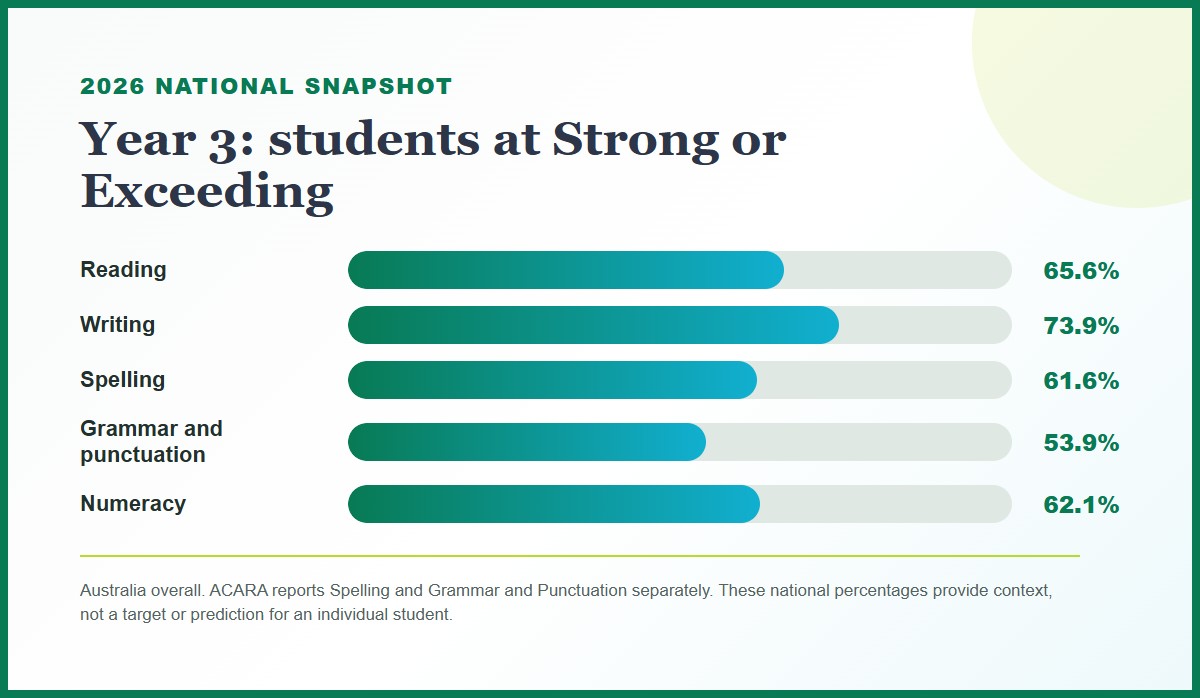
In the 2026 national results, the percentage of Year 3 students at Strong or Exceeding ranged from 53.9% to 73.9% across the five areas ACARA reports. The chart keeps every area visible so one figure is not mistaken for the whole year level.
The Year 3 chart is a national snapshot from the first scheduled assessment year. It cannot show whether your child was unsure about the screen, the wording or the underlying skill, so use the actual work and teacher feedback for the next decision.
ACARA reports Spelling and Grammar and Punctuation separately in the Year 3 chart, although both belong to the Conventions of Language assessment pathway.
Year 3 questions
Should a parent sit beside a Year 3 child?
A parent can stay nearby for reassurance and practical help, particularly during a first session. The child should still select or write the answers independently. If the child regularly needs a question explained, record that pattern rather than explaining every item away.
What if my child has never used an online test?
Begin with the official public demonstration site and a short look through the Ezy Math pack. Familiarity with selecting, typing, scrolling and moving between questions can reduce avoidable confusion. It does not need to become a long computer lesson.
What if the first result is low?
Treat it as a starting sample. Check whether the child misunderstood the format, rushed, became tired or repeatedly missed one skill. One practice result should not be treated as a prediction of the child’s final NAPLAN result or broader ability.
Other NAPLAN resources
Official information used for this guide
Delivery, assessment and national-result details were checked against these official sources on 22/08/26. Use the links below to check the latest information.
What they say about our tutoring
Mitchell is happy with the new tutor, thank you. Sean is a good communicator which makes Mitchell feel more relaxed thanks again.
We are very happy with Sheetal. Timothy is making great progress and we are happy to continue. We will have Tim do his Navy test in a few weeks and if we need to do a bridging course we will ask Sheetal to tutor him with that as well.