
Find tutor 🔍
How much tutoring does your child need?

Choose a Year 7 domain: Open Numeracy, Reading, Writing or Conventions of Language. Each domain includes three practice tests.
Year 7 NAPLAN arrives during a major school transition. Students are managing new subjects, teachers and routines while the assessment asks them to apply literacy and numeracy skills with increasing independence. Practice should fit around that transition rather than becoming another source of overload.
The Year 7 library gives your child a repeatable process: choose a subject, try one test, review the difficult questions, work on selected gaps and return to a later set. This makes each paper part of the learning instead of a race for a higher total.
By Year 7, your child can take a larger role in the review. Help schedule the work and ask good questions. Let your child identify what felt difficult, compare their method with the explanation and choose the next skill to practise.
Choose a Year 7 domain
Year 7 students are adjusting to greater secondary-school independence. Let your child choose a starting domain, predict likely pressure points and take responsibility for marking questions that need a later discussion.
Each card previews three important Year 7 skills and names the files included across the domain’s three tests. Open the full domain page for its six-part skill map and download cards.
Numeracy practice tests
NAPLAN Numeracy draws on number and algebra, measurement and geometry, and statistics and probability.
Important Year 7 skills:
- Integers, fractions, decimals and percentages
- Non-calculator fluency and operation choice
- Algebraic expressions and patterns
Each of the three test cards provides:
- Mixed calculator conditions question paper
- Answer key and worked solutions for the mixed paper
- Separate non-calculator question paper
- Answer key and worked solutions for the non-calculator paper
Reading practice tests
NAPLAN Reading asks students to understand and interpret a range of written and visual texts.
Important Year 7 skills:
- Connecting ideas and drawing conclusions
- Viewpoint, tone and purpose
- Text structure and idea development
Each of the three test cards provides:
- Reading question paper
- Original reading magazine
- Answer key and explanations
Writing practice tests
NAPLAN Writing asks students to create a response to a prompt.
Important Year 7 skills:
- Sustained purpose and audience
- Controlled narrative or persuasive structure
- Substantial idea development
Each of the three test cards provides:
- Writing prompt
- Writing exemplar booklet with criterion-based examiner commentary
- Reusable writing response booklet
Conventions of Language practice tests
NAPLAN Conventions of Language covers spelling, grammar and punctuation.
Important Year 7 skills:
- Roots, morphemes and complex spelling
- Word classes and precise form
- Agreement and reference across longer sentences
Each of the three test cards provides:
- Conventions of Language question paper
- Answer key and explanations
The Year 7 maps emphasise method, evidence, cohesion and systematic checking. Those habits matter beyond NAPLAN, so the best follow-up should also make current secondary work clearer or more efficient.
Reading, Numeracy and Conventions of Language use tailored online test design. The Year 7 maps are therefore practical guides for reviewing visible work, not predictions of the exact questions a child will receive.
How to use the three Year 7 practice tests
Choose the first set together, then hand over the attempt. Before another paper is opened, your child should be able to name the content focus and the process change being tested.
Practice Test 1
Use the first test to see what your child can do independently. Mark confident, uncertain and unfinished questions for the review.
Practice Test 2
Open the second test after focused teaching and practice. Check whether the chosen skill and checking habit have improved.
Practice Test 3
Keep the third test unseen for a later check. Use it when your child is ready to apply the improvement without reminders.
A sensible Year 7 practice sequence
- Plan: Select one domain and book a realistic session into the week.
- Attempt: Complete Practice Test 1 independently and flag uncertain items.
- Review: Sort errors into knowledge, interpretation, method, checking and time management.
- Improve: Practise the two highest-value patterns across several short sessions.
- Recheck: Use Practice Test 2, compare the pattern, then save Test 3 for a final fresh attempt.
Separate the complete attempts and keep the practice priorities narrow. The goal is not to create a second school program at home, but to help your child see and act on a useful pattern.
After Practice Test 1: Year 7
- Compare the student’s confidence notes with the answers and working.
- Identify one subject skill and one test-taking process that affected several items.
- Ask the student to plan the follow-up and explain when a fresh paper will be useful.
What a parent of a Year 7 child can do
- Let the student choose which domain to begin with and explain the reason for that choice.
- Put practice into a weekly plan that leaves room for schoolwork, sleep and ordinary activities.
- Ask the student to mark uncertain items during the attempt and explain one solution afterwards.
- Use the skill map to choose priorities together rather than prescribing a long remedial list.
- Encourage the student to record one process improvement as well as one content skill.
Use questions more than instructions. Ask where the evidence came from, why a method was chosen and what your child will alter next time, then step back as ownership grows.
Year 7 national results in context
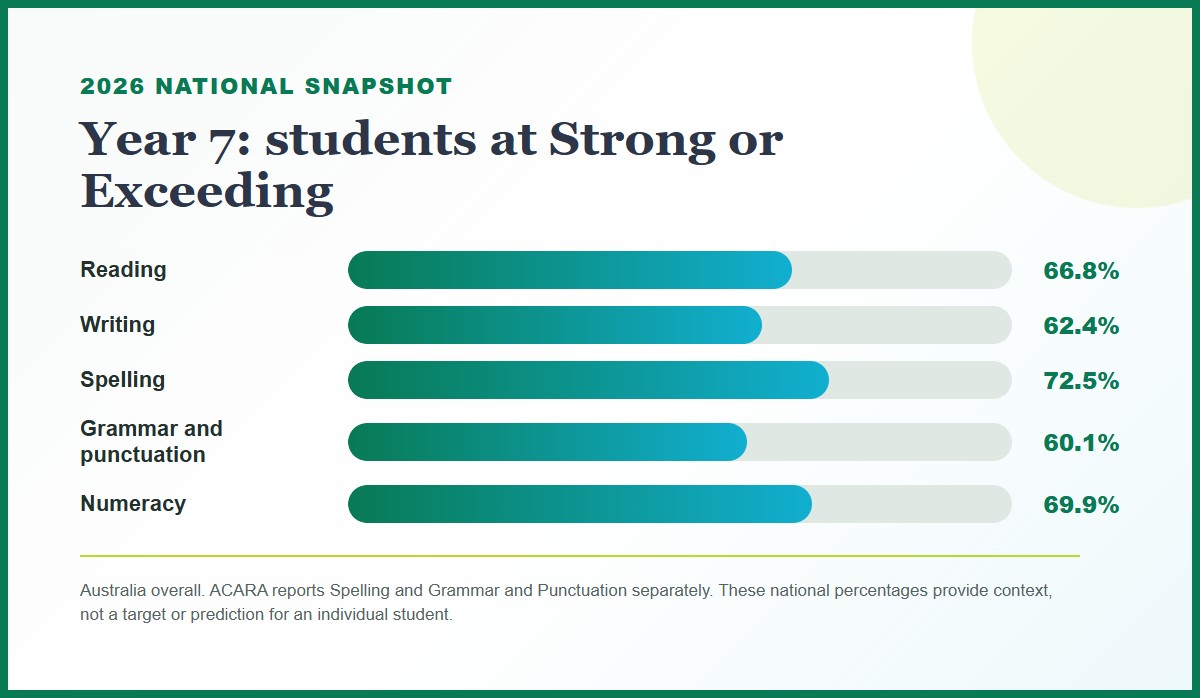
In the 2026 national results, the percentage of Year 7 students at Strong or Exceeding ranged from 60.1% to 72.5% across the five areas ACARA reports. The chart keeps every area visible so one figure is not mistaken for the whole year level.
The Year 7 chart gives national context during the transition to secondary school. It cannot identify an individual student’s needs, so connect any concern with the paper, current classwork and teacher feedback before increasing practice.
ACARA reports Spelling and Grammar and Punctuation separately in the Year 7 chart, although both belong to the Conventions of Language assessment pathway.
For 2026 Writing, ACARA advises caution because of a technical disruption that affected many students in Years 5, 7 and 9 on 11/03/26. ACARA reports that the national results were minimally impacted and remain valid for reporting.
Year 7 questions
How independent should a Year 7 student be?
The student should complete the questions independently and take part in planning and reviewing. Adult help can still be useful for scheduling, interpreting the pack and arranging support when a repeated gap is found.
Why separate calculator and non-calculator practice?
The two situations call on overlapping but different habits. Students need reliable number sense and written methods without a calculator, plus the judgement to use a calculator accurately when it is allowed.
What if school transition is already overwhelming?
Reduce the volume. One short familiarisation session may be enough initially. NAPLAN practice should not displace sleep, essential schoolwork or support for a student who is already under strain.
Other NAPLAN resources
Official information used for this guide
Delivery, assessment and national-result details were checked against these official sources on 22/08/26. Use the links below to check the latest information.
What they say about our tutoring
Mitchell is happy with the new tutor, thank you. Sean is a good communicator which makes Mitchell feel more relaxed thanks again.
We are very happy with Sheetal. Timothy is making great progress and we are happy to continue. We will have Tim do his Navy test in a few weeks and if we need to do a bridging course we will ask Sheetal to tutor him with that as well.