
Find tutor 🔍
How much tutoring does your child need?

Choose a Year 5 domain: Open Numeracy, Reading, Writing or Conventions of Language. Each domain includes three practice tests.
Year 5 students have usually encountered NAPLAN before, but two years of learning make the experience different. The useful question is not whether the child remembers Year 3. It is whether the child can now handle longer ideas, multi-step thinking and greater independence across the four domains.
Practice works best when it reveals a pattern. Your child may understand a concept but lose marks through reading too quickly. They may also work carefully but have a specific gap in fractions, punctuation or inference. The Year 5 tests and explanations help you tell those situations apart.
You can gradually step back from supervising every action. Set up the session, agree on what will happen if your child feels stuck, and let them complete a meaningful section independently. The review conversation afterwards is usually more valuable than hovering during every question.
Choose a Year 5 domain
Year 5 practice can build independence as well as subject knowledge. Ask your child which domain to begin with and what they expect to find easy or difficult before opening a test.
Each card previews three important Year 5 skills and names the files included across the domain’s three tests. Open the full domain page for its six-part skill map and download cards.
Numeracy practice tests
NAPLAN Numeracy draws on number and algebra, measurement and geometry, and statistics and probability.
Important Year 5 skills:
- Whole numbers and efficient operations
- Fractions, decimals and part-whole thinking
- Patterns and number sentences
Each of the three test cards provides:
- Numeracy question paper
- Answer key and worked solutions
Reading practice tests
NAPLAN Reading asks students to understand and interpret a range of written and visual texts.
Important Year 5 skills:
- Direct detail across a longer text
- Main and supporting ideas
- Inference across sentences and sections
Each of the three test cards provides:
- Reading question paper
- Original reading magazine
- Answer key and explanations
Writing practice tests
NAPLAN Writing asks students to create a response to a prompt.
Important Year 5 skills:
- Audience, position and text type
- Purposeful overall structure
- Developed ideas and examples
Each of the three test cards provides:
- Writing prompt
- Writing exemplar booklet with criterion-based examiner commentary
- Reusable writing response booklet
Conventions of Language practice tests
NAPLAN Conventions of Language covers spelling, grammar and punctuation.
Important Year 5 skills:
- Prefixes, suffixes and spelling patterns
- Word form and grammatical meaning
- Agreement, tense and pronoun reference
Each of the three test cards provides:
- Conventions of Language question paper
- Answer key and explanations
The Year 5 maps move beyond basic familiarity and show where explanation, checking and connected thinking become more important. They give you more useful language than a broad comment such as needing to improve Reading or Numeracy.
Reading, Numeracy and Conventions of Language use tailored online test design. The Year 5 maps are therefore practical guides for reviewing visible work, not predictions of the exact questions a child will receive.
How to use the three Year 5 practice tests
Use Practice Test 1 to find a repeated problem, then let your child help choose one skill and one checking habit. Practice Test 2 should show whether that change helped.
Practice Test 1
Use the first test to see what your child can do independently. Mark confident, uncertain and unfinished questions for the review.
Practice Test 2
Open the second test after focused teaching and practice. Check whether the chosen skill and checking habit have improved.
Practice Test 3
Keep the third test unseen for a later check. Use it when your child is ready to apply the improvement without reminders.
A sensible Year 5 practice sequence
- Baseline: Complete one full subject test and record confidence beside uncertain answers.
- Review: Compare confident wrong answers, uncertain correct answers and rushed mistakes.
- Target: Select one content gap and one test-taking habit for attention.
- Practise: Use short school-aligned tasks and revisit the worked explanation.
- Check: Use Practice Test 2 after a meaningful learning interval, then reserve Test 3 for a later independent check.
Leave enough time for the chosen skill to improve through ordinary schoolwork and short practice. A Year 5 child can keep a simple note about what changed before the next complete test.
After Practice Test 1: Year 5
- Ask your child to show one answer they feel confident about and explain why.
- Compare one uncertain response with the guide and name the skill or process involved.
- Agree on one content focus and one checking habit before scheduling another set.
What a parent of a Year 5 child can do
- Ask the student what they remember about the assessment before supplying an explanation.
- Agree on a realistic session length and break point.
- Let the student flag uncertain questions rather than seeking immediate adult confirmation.
- During review, ask what the student was thinking before showing the worked explanation.
- Choose the next practice activity from a repeated pattern. One surprising error may be a simple slip.
Move from directing the session towards asking useful questions. Your child can flag uncertainty, explain a choice and help decide what evidence would show improvement.
Year 5 national results in context
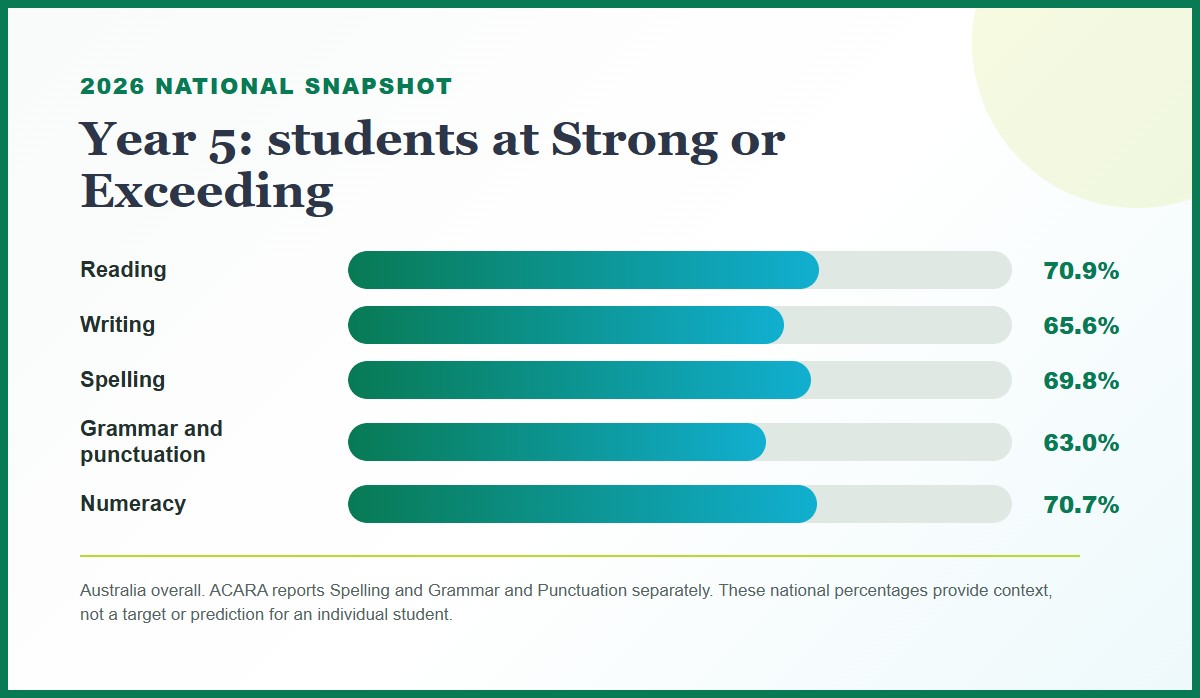
In the 2026 national results, the percentage of Year 5 students at Strong or Exceeding ranged from 63.0% to 70.9% across the five areas ACARA reports. The chart keeps every area visible so one figure is not mistaken for the whole year level.
The Year 5 percentages describe participating students across Australia, not the meaning of one home attempt. Compare the chart with classroom learning only as background, then use repeated patterns in your child’s paper to choose the next step.
ACARA reports Spelling and Grammar and Punctuation separately in the Year 5 chart, although both belong to the Conventions of Language assessment pathway.
For 2026 Writing, ACARA advises caution because of a technical disruption that affected many students in Years 5, 7 and 9 on 11/03/26. ACARA reports that the national results were minimally impacted and remain valid for reporting.
Year 5 questions
Should Year 5 practice be harder than Year 3 practice?
It should suit the Year 5 assessment and curriculum expectations. The key differences should appear in the thinking, text complexity and independence expected.
Should we compare the result with Year 3?
Past results may provide context, but the practice review should focus on current evidence. Look at what the child can explain now, which errors repeat and whether the chosen strategy works.
How much typing practice is useful for writing?
Enough that keyboard use does not dominate the task. Planning, sentence construction, paragraphing, vocabulary and revision remain the important writing work. Short regular typing in meaningful writing is usually more useful than speed drills alone.
Other NAPLAN resources
Official information used for this guide
Delivery, assessment and national-result details were checked against these official sources on 22/08/26. Use the links below to check the latest information.
What they say about our tutoring
Mitchell is happy with the new tutor, thank you. Sean is a good communicator which makes Mitchell feel more relaxed thanks again.
We are very happy with Sheetal. Timothy is making great progress and we are happy to continue. We will have Tim do his Navy test in a few weeks and if we need to do a bridging course we will ask Sheetal to tutor him with that as well.