
Find tutor 🔍
How much tutoring does your child need?
Download a Year 7 Reading test: Choose Practice Test 1, 2 or 3. Each card lists the question paper and every matching answer or review file.
Year 7 NAPLAN Reading includes three free Ezy Math practice tests. Each card names the question paper, original reading magazine, answer key and explanations.
For Year 7, useful practice connects the test with the greater independence expected in secondary school. Your child should help identify the pattern and plan the follow-up.
In the first years of secondary school, this page helps you see how your child reads, not only how many answers were correct. A missed question may come from overlooking a key word, using the wrong part of the text or making an inference without enough evidence.
Year 7 NAPLAN Reading practice tests
Start with the question paper and keep the answer key and explanations closed until your child finishes. Do not interrupt to correct mistakes. For independent Year 7 practice, encourage a return to the text for evidence instead of an answer from memory.
Open the reading magazine beside the question paper. Keep the answer guide closed until the attempt is finished, then return to the text together and check the evidence behind each answer.
During the later discussion, ask for the words, image or text feature that supports an answer before discussing whether it is correct.
Reading Practice Test 1
For an early secondary starting point, notice whether your child returns to the text and uses the right detail to support an answer. Agree on the conditions beforehand, then let your child manage the attempt and mark questions that deserve a second look.
What you can download:
- Download Reading question paper (PDF, 16 pages)
- Download Original reading magazine (PDF, 12 pages)
- Download Answer key and explanations (PDF, 16 pages)
Reading Practice Test 2
After the student has worked on a stated priority, check whether the evidence is being found more accurately. Before the next set, ask your child to name the method, evidence or editing habit they have been improving.
What you can download:
- Download Reading question paper (PDF, 16 pages)
- Download Original reading magazine (PDF, 12 pages)
- Download Answer key and explanations (PDF, 17 pages)
Reading Practice Test 3
For a later check without adult prompts, see whether the stronger reading habit carries across to unfamiliar texts and question types. Save the last paper for a later check that your child can organise and review with less adult direction.
What you can download:
- Download Reading question paper (PDF, 16 pages)
- Download Original reading magazine (PDF, 12 pages)
- Download Answer key and explanations (PDF, 17 pages)
What Year 7 NAPLAN Reading covers
NAPLAN Reading asks students to understand and interpret a range of written and visual texts. These practice tests encourage your child to return to the text, locate evidence, connect ideas, interpret vocabulary in context and separate stated information from an inference.
NAPLAN Reading uses imaginative, informative and persuasive texts. Questions can draw on written language, text structure, vocabulary, illustrations, diagrams, tables and other visual features.
Year 7 Reading is part of the tailored online design. A student can see shorter or longer, simpler or more complex texts depending on the pathway through the testlets, so practice should build flexible evidence-finding rather than memorised tricks.
The six cards below explain the main parts of Year 7 Reading in parent-friendly terms. Read the cards that match what you saw in your child’s work. You do not need to explain every mistake or use every card.
Compared with Year 5, Year 7 Reading asks for more independence and more explanation of the choices made.
Year 7 students need to track viewpoint, tone and structure while choosing evidence from longer and more varied texts.
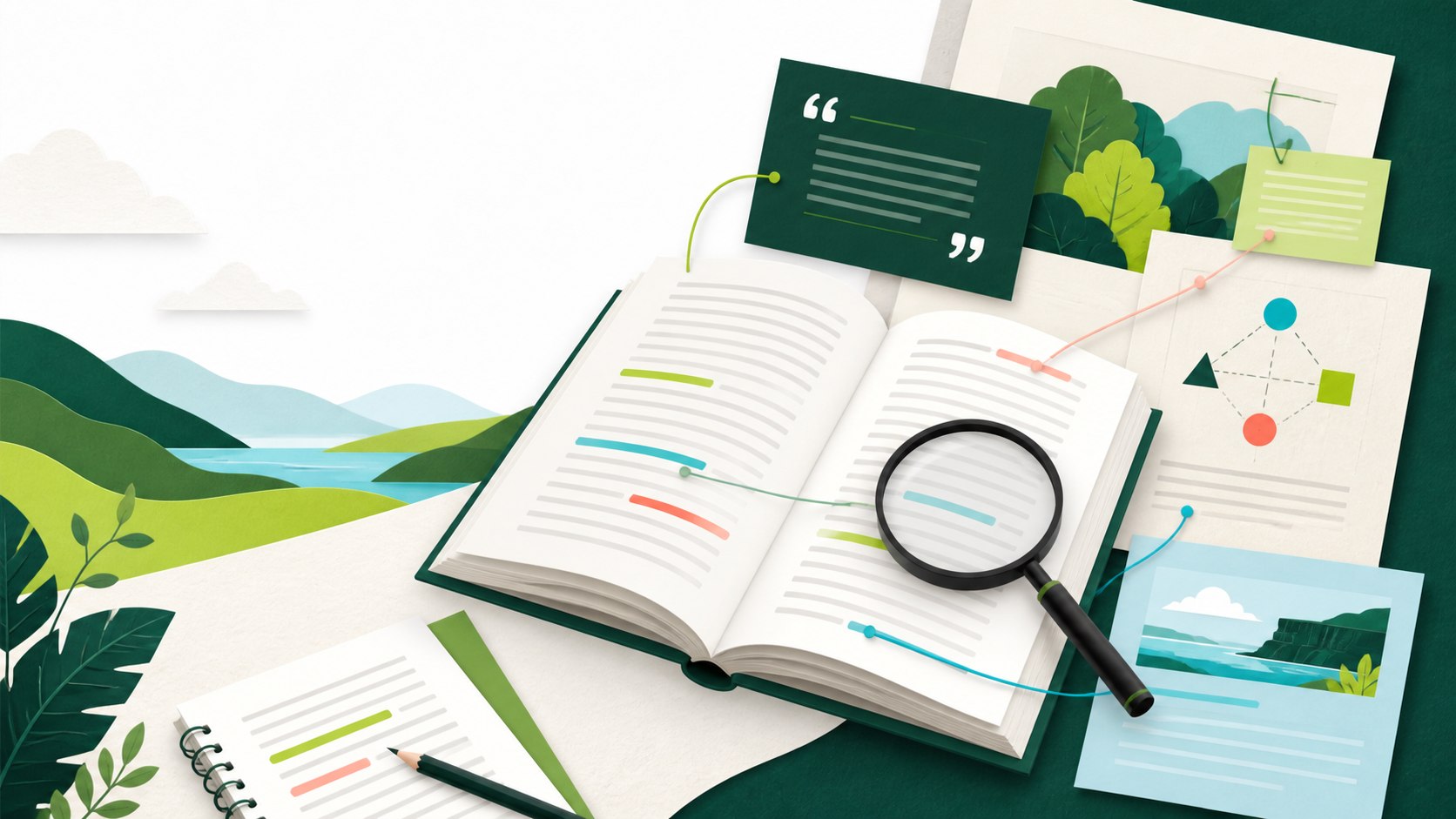
Year 7 Reading skill map
1. Connecting ideas and drawing conclusions
What this part checks: Making inferences by bringing together information from different parts of imaginative, informative and persuasive texts.
What your child may be asked to do: Draw a conclusion from details separated across the text or compare how two sections develop an idea.
What to look for afterwards: Can the student map the conclusion back to more than one piece of evidence?
2. Viewpoint, tone and purpose
What this part checks: Identifying an author or narrator’s perspective, the tone created and how these choices serve a purpose.
What your child may be asked to do: Decide whether a phrase signals approval, doubt or criticism, or compare viewpoints in two extracts.
What to look for afterwards: Did the student identify the precise words that create the tone rather than relying only on the topic?
3. Text structure and idea development
What this part checks: Recognising chronological, cause-effect, problem-solution and argument structures, including less predictable combinations.
What your child may be asked to do: Explain why a section appears where it does or identify how an idea is developed through the text.
What to look for afterwards: Can the student describe the job of the section and its connection to what comes before and after?
4. Technical and figurative language
What this part checks: Interpreting topic-specific vocabulary, figurative language and deliberate word choices through context.
What your child may be asked to do: Infer a technical term’s meaning or explain how a metaphor shapes the reader’s understanding.
What to look for afterwards: Did the student distinguish the literal meaning from the effect created in this specific passage?
5. Claim, evidence and substantiation
What this part checks: Separating claims, examples and evidence, and judging which information most strongly supports a position.
What your child may be asked to do: Choose the evidence that best supports an argument or explain why one statement is insufficient.
What to look for afterwards: Did the student evaluate the relevance and strength of the evidence? A true statement may still be a weak answer.
6. Diagrams, tables and integrated texts
What this part checks: Processing written and visual information together, including graphics that add content not repeated in prose.
What your child may be asked to do: Use a table to qualify a written claim or combine a diagram with an explanation to answer a multi-part question.
What to look for afterwards: Were labels, units, scale and exceptions checked before the sources were combined?
Viewpoint example: see how the explanation should work
The article calls the new garden ‘a small patch with a surprisingly large job’.
The phrase signals a positive viewpoint and prepares the reader for evidence about several benefits. A good response connects the language choice to the article’s purpose and explains its effect.
This example is separate from the practice tests, so you can discuss it without giving away an answer from the papers.
Ask the student to defend the explanation and point to the evidence or method behind it. Ask for the exact clue that supports the explanation. Then ask why another believable detail would not answer the question as well. You can also ask: What is the strongest evidence, and why is it stronger than the other plausible detail?
After Practice Test 1: Year 7 Reading
Compare your child’s confidence with the actual work, especially where a plausible answer hid weak evidence or an inefficient method.
Ask: What is the strongest evidence, and why is it stronger than the other plausible detail?
- During the review, underline the important words in one missed question and say what the question is asking.
- For the follow-up work, point to the exact sentence, image or text feature that supports the answer.
- Before the next full attempt, compare two believable answers and explain why one has stronger evidence.
Do not review every missed question at once. Choose one repeated reading habit, practise it with a short text and return to the other questions later.
Choose one content priority and one process priority that also support current classroom learning.
Your role with a Year 7 child
- Let the student choose which domain to begin with and explain the reason for that choice.
- Put practice into a weekly plan that leaves room for schoolwork, sleep and ordinary activities.
- Ask the student to mark uncertain items during the attempt and explain one solution afterwards.
2026 national context for Year 7 Reading
Reading
66.8% of participating students were reported at Strong or Exceeding nationally.
10.7% were reported as Needs additional support.
These figures describe results across Australia. They do not explain what happened in your child’s attempt. During the later discussion, ask for the words, image or text feature that supports an answer before discussing whether it is correct.
For an early secondary student, use the national figures only as context. Your child’s choice of evidence will tell you much more about the next reading habit to practise.
A total from an Ezy Math Year 7 Reading practice test is not an official NAPLAN scale score. When the student chooses a priority, use your child’s work rather than a comparison with the national percentage.
Questions parents ask about Year 7 Reading
What should I notice first in a Year 7 Reading attempt?
When the student reviews the attempt, compare the evidence behind one correct answer and one missed answer. The difference between those two choices often reveals the most useful next step.
When should my child open Year 7 Reading Practice Test 2?
Before the next set, ask your child to name the method, evidence or editing habit they have been improving. After the student can describe the change being tested, practise the reading habit found in Test 1 with ordinary school or home reading. Use Test 2 when your child can explain what they will do differently.
Related NAPLAN resources
If the same issue is affecting classwork, take one question, the relevant text and your child’s explanation to the teacher or tutor.
Official information used for this guide
The Year 7 Reading format and 2026 national figures were checked against the official NAP and ACARA sources below on 22/08/26.
What they say about our tutoring
Mitchell is happy with the new tutor, thank you. Sean is a good communicator which makes Mitchell feel more relaxed thanks again.
We are very happy with Sheetal. Timothy is making great progress and we are happy to continue. We will have Tim do his Navy test in a few weeks and if we need to do a bridging course we will ask Sheetal to tutor him with that as well.